A business changes its prices, expands its team or enters a new market because it sees an opportunity. Understanding the results helps management decide where to invest next, what to refine and which successes to repeat. The sooner that understanding arrives, the sooner the business can build on it.
That is what management reporting should deliver: a clear basis for the next decision.
Before co-founding Advise, I spent 20 years in finance and corporate advisory, working across acquisitions, restructuring and funding, and analysing around 500 companies. That experience shaped my conviction that understanding financial performance is a core management capability. Leaders need to connect the choices they make with the results that follow to underpin the next decision.
Understanding what drives results
Consider a business that lowers prices with the goal to increase sales and total margin. Revenue rises and margins narrow. Has the additional volume increased the overall margin? Are customers buying more frequently? Which products or customer groups are benefiting most?
The answers help management decide whether to extend the approach, refine it or try something else. They also reveal where success can be repeated. A strong result in one location becomes more useful when the business understands what other locations could learn from it. These insights need to be used by management and shared with relevant people across the organization so everybody gets involved and acts towards the goal.
Management reporting and performance reviews earn their place in everyday management when it is used to support business decisions, helps people explain changes in performance and decide what to do next.
Making room for analysis
Getting to that understanding takes work. The 2026 FP&A Trends Survey, based on 475 respondents, found that financial planning and analysis teams spend 47% of their time collecting and validating data, while only 32% goes towards generating insights and driving action.
There is a substantial opportunity in shifting that balance. Research from McKinsey found that finance professionals in a handful of organizations with extensive AI adoption spent 20–30% less time processing data, freeing up capacity to support business strategy. The McKinsey report also states, “By quickly generating customized reports that maintain appropriate security and hierarchical-access controls, AI tools also make it easier for finance departments to provide insights across their organizations."
Together, these improvements give managers and finance teams more time to investigate performance, collaborate across departments and use financial insights to assess the results of business decisions.
But access to information is only part of the equation. People responsible for staffing, purchasing, project management, planning, pricing, and sales also need to understand how their everyday decisions affect performance. Reports become more useful when those people can explore the numbers, ask questions and connect financial results with what they see in the business.
Finance brings the financial perspective. Operational teams bring the context behind the figures. Together, they can establish what is driving a result and where to focus their efforts.
Closing the feedback loop
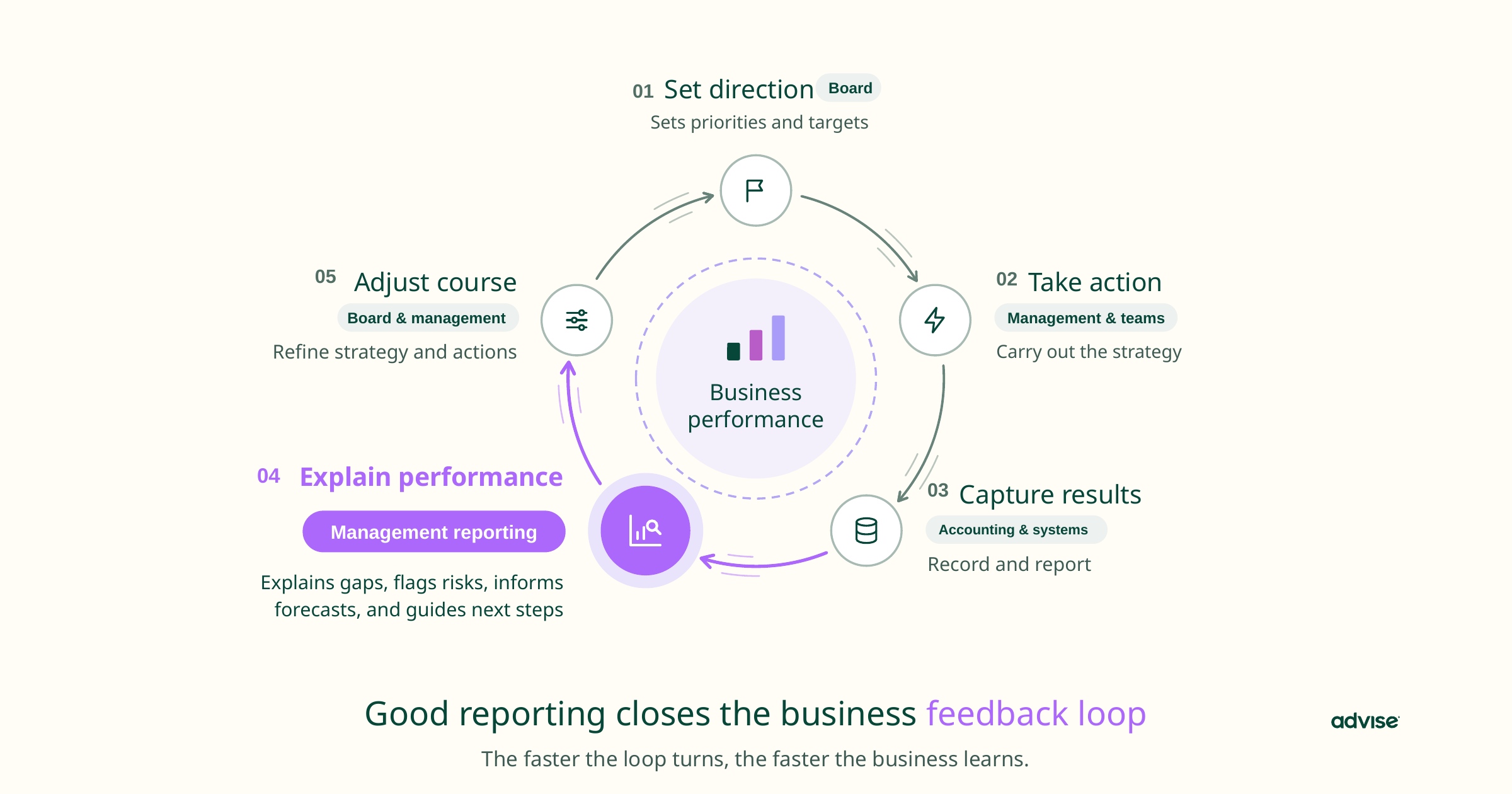
The business feedback loop connects direction, action, results and learning. Management reporting closes that loop by relating actual performance to the expectations behind a decision.
The next step needs clear ownership. What will change? Who will take responsibility? When will the team check whether it worked?
A promising result might justify further investment. A successful approach could be shared across locations. A change in pricing could be refined and assessed again. Each response creates another opportunity to learn and improve.
That is the thinking behind Advise: making financial information easier to access and understand, so teams can use it in their everyday decisions. Technology can support that process. Leaders give it purpose by making time to discuss the results and agree on what happens next.
At your next management meeting, take one significant decision and ask: what did we expect, what have we learned, and what will we do next?
The value of good reporting is in how confidently you can answer and act.